
As soon as we set foot on Syrian ground everything around us seemed to slow down. It started with the border guard automatically flicking through our passports for 15 minutes over and over again but getting distracted by whatever was happening around him. Holding the visa stamp in one of his hands he was getting himself a cup of tea, chatting to whoever was passing by, answering the phone while continuing to flick through our passports. Then he seemed to remember what he was supposed to do and started scribbling something in Arabic on a random page in our passport (in James’s case on the front page of his passport – that’ll be great for any future use…). Finally he stamped our passports although it took him another few minutes to hand them back to us.
In Syria the clocks are simply ticking at a different pace. Even the cars drive a lot slower than in the neighbouring countries and generally don’t speed up and beep at you every time you want to cross the street. People have a lot of time to chat to us in shops, food stands or restaurants. Occasionally you may have to track down a waiter or sales person. While the older generation mostly speaks French, since France used to hold its mandate over Syria from WWI to 1943, the younger people speak pretty good English. It’s nice to be able to speak to everyone so easily since Arabic isn’t a language that you can pick up quickly. Pronouncing the most important words like hello, thank you, good bye, one, two, three is ok. However, reading Arabic writing after only a few days is out of the question. This makes hailing down the right minibus in cities near impossible because all the destinations look the same. So the only option is to catch minibuses at terminals, walk for several kms or take taxis if the distance is too great.
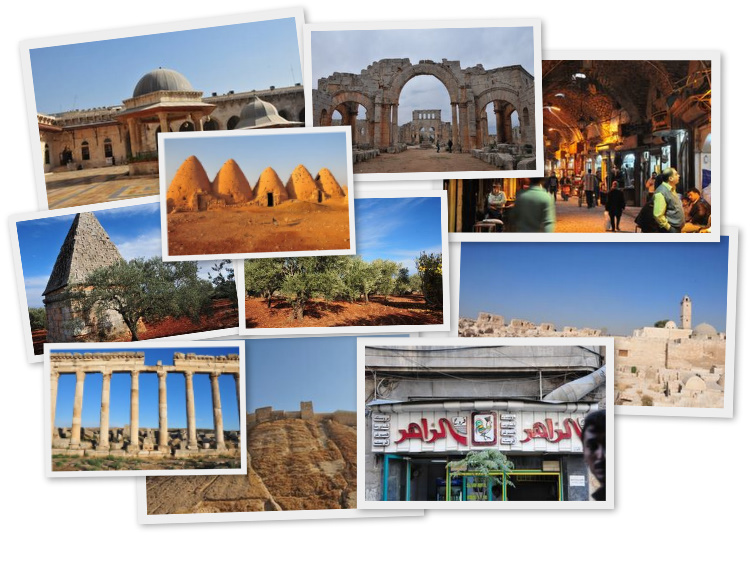
Our first stop in Syria was Aleppo or Halep as it’s called in Arabic. The centre of Aleppo where the most interesting parts are is pretty compact. There is the small but atmospheric old city with a nice mosque and a pretty impressive citadel with good views. It also has a great, lived in, several hundred year old souq where the main alley runs for 1,5 km across the old city. In this part of town the people are predominantly dressed conservatively. In fact Syria is so far the only country where we’ve seen quite a few women completely covered up with a black veil and gloves. In between the old city and the new city is the Christian quarter Al-Jdeida with old town houses and churches for any Christian religion you can think of. Here you see a mix of conservatively dressed and fairly liberally dressed people wandering through the streets. North of the Al-Jdeida and the new city lies Al-Aziziah where you find American style diners and French inspired coffee houses. In this quarter hip and beautiful people sip their iced lattes and you most definitely won’t see a single head scarf. The new city is where all the banks, offices and government buildings are and not to forget no shortage of cinemas showing martial art or soft porn movies. Outside of the cinemas you can see trashy seventies style posters of half naked women and guns aimed to attract an exclusive male clientele. Funnily enough, these ads show the scenes that the censors have apparently cut from the movies. Definitely not what you expect to see in Syria…
Distances aren’t very big in any of the Middle Eastern countries and there is good public transport between the main cities. But if you want get off the main highways you either need to hitch, have your own car or hire a driver for a few hours or a day which can be the most economical way to see a lot in a short period of time. So we thought we’d give it a try and organised a driver for a day to check out some historical sites in the vicinity of Aleppo and around Hama, a town about a two hour ride south. Our driver turned out to be a really nice young Syrian Kurdish guy who like all the Kurds we met in Syria introduced himself with his first name and emphasised that he was Syrian Kurdish to point out his ethnicity.We were eager to try out the very few words we remembered in Kurdish which he very much appreciated but also made him giggle. It’s interesting to experience how important this distinction is in this country. Even more we feel than in Turkey.
We spent a very nice day starting with a visit of Qala’at Samaan, the ruins of the Basilica of St Simeon. It was built to commemorate St Simeon Stylites who, as the legend goes, spent most of his life seeking solitude to the extend that he would sit on higher and higher pillars from where he would preach to his followers. In the end he was sitting on a 18m high pillar so that people couldn’t touch him. We’re not going to comment this legend but the ruins themselves were surprisingly impressive. Our next stop were the Byzantine Dead Cities of Al-Bara and Serjilla which James particularly liked and ended the day with a stop at the Roman ruins of Apamea. The main part that’s left at Apamea is a massive boulevard which is 2 km long and flanked all the way by several meter high pillars. I thought I had seen enough Roman ruins but walking down the boulevard felt like being on a movie setting of Ben Hur or the like.
Hama unfortunately didn’t do it for us. Is was a combination of many things. Bad weather and terrible night sleep because it was so loud in our hotel. Our room wasn’t a place you wanted to hang out mainly because it was freezing and stunk of smoked sausage. The famous “noria”, water wheels of 20m diameter, aren’t really an impressive sight either because the rivers were dried up and there was rubbish piling up everywhere in murky water. Rubbish is unfortunately a major problem in this part of the world. It is depressing to see piles of plastic bottles and bags, torn clothes, shoes, tires and whatever else lying around in the streets, in front of houses, all over the fields and along the highways. Syria is by far the worst we’ve seen although sadly parts of Turkey aren’t much better.
We didn’t hang around Hama very long but did check out the Byzantine ruins of Qasr ibn Wardan. They’re not the biggest attraction but we had this lovely old man showing us around the ruins and pointing out every little detail in Arabic mixed with the few words of English and French he knew. This definitely made the visit a lot more interesting. There are also some curious “beehive” houses dotted around this area and we stopped on our way back to Hama to get a glimpse of these little, cone shaped houses which are built in a similar way as the ice houses in Iran.
It’s easy to overdose on Roman ruins, crusader castles and mosques in the Middle East because there are so many of them. So we decided to check out the Syrian coast for a change in scenery and headed to the port city Lattakia, a popular beach place among Syrians and other Arab countries. It’s not necessarily a pretty city but we liked seeing a different side to traditional Syria. We couldn’t help staying away from historical sites though and ended up taking a minibus to the village Al-Haffa to check out the crusader castle Qal’a at Saladin. The scenery is the main draw which unlike most of Syria is very green, almost lush in this area. But then the castle wasn’t bad either and I got carried away again thinking of those 1950s King Arthur or Lancelot movies or the like.
There wasn’t much keeping us in Lattakia after visiting Qal’a at Saladin. Not even the take away coffee you can get from these really cool little stands on ever corner. Mostly they are just basic coffee machines on tables where vendors hand out espresso or cappuccino sitting comfortably on a battered chair in true relaxed Syrian fashion. The weather wasn’t too great for a swim either although we did see a few brave local men jumping into the sea and some covered up women stepping into the water up to their knees.
From Lattakia it’s only a two hour ride in a shared taxi across the border to Lebanon. So we decided to go there for a little while and then cross back into Syria to meet up with a good friend from Vienna who is flying out to Damascus for the Christmas holidays and the New Year. It wasn’t hard to catch a cab since there were already two men waiting and keen to head off. The only complication was the tons of paperwork that needed to be filled in before we could eventually head off and the usual problem that no one knows Austria or mixes it up with Australia. In the end we got the ok and hopped in the cab only to go through the same procedures at the actual border crossing again. After all the land borders we’ve crossed and the times we’ve spent waiting, being questioned or searched we could write a book with border crossing anecdotes.
Wow what a beautiful country, amazing architecture.
Happy Christmas! Btw, where will you be spending it?!
Again jealous of your amazing journey, keep up the good work
Cheers,
Rich
We’ll be in Damascus for Christmas and New Year… should be fun!