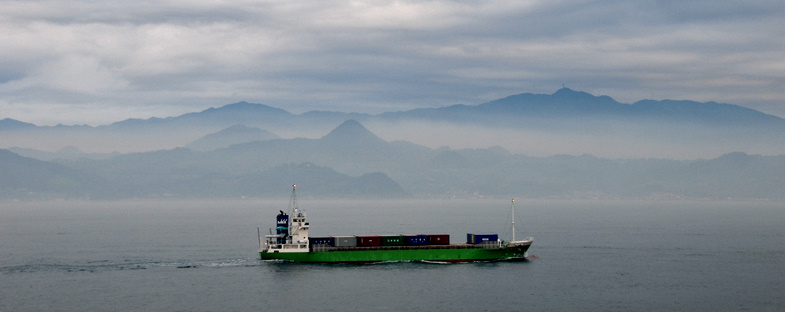
Our trip with the ferry from Kobe to the Chinese port of Tianjin turned out to be a very relaxing ride and the 50 hours in the boat didn’t even feel that long. It was nothing like the ferry we took from Qiandao, China, to Incheon, South Korea three years ago where we got stuck with a lot of drunken Chinese businessmen who were very keen to do business with us or were trying to get us pissed. The ferry was only half full and it was really quiet at night. We spent the two days reading, listing to music or watching the Sopranos (we hadn’t seen the show before and are totally addicted to it now – ‘what can you do!?’…). When not relaxing we walked up and down the ship or in circles on deck to stretch our legs. On the first day we travelled closely along the Japanese coast which was pretty stunning. By the afternoon of the second day all there was to see was the wide open sea and nothing else until we arrived a the industrial port of Tianjin where we met heaps of oil tankers and a very hazy sky awaited us. Yes, you’ll be shocked to learn it’s true the pollution in big Chinese cities is pretty bad.
We had met a great Japanese guy of Chinese origin on the ship who took us under his wing. Together we took the local bus to the closest train station where a bullet train connected to Beijing. We couldn’t believe our eyes, it was like being back in Japan. In fact at 350 km/h it went faster than any Shinkansen we had been on in Japan and in less than an hour we arrived at Beijing South. We had been in Beijing before on our trip three years ago so we kind of knew our way around the city but we had some trouble finding cheap accommodation the first night. We had gotten used to how easy travelling is in Japan but we were lucky in the end and found two beds in a shared room for the night after walking around for two hours and being turned away everywhere. We’re definitely feeling like backpackers now 🙂
We were really enjoying being back in China though since we had such a great time three years ago. But the main reason why we went to Beijing was to get our visa and train ticket for Mongolia sorted. However that plan turned out to be quite an odyssey. It took us four trips to the embassy until we finally had the visa sticker in our passport. The first time the embassy was closed because of a National holiday so we had to treat ourselves to a ‘pretzel’ and a ‘laugen croissant’ (yes in China and not only in Austria, so weird) at a coffee shop in the area. The second time the embassy shut the shutters without saying a word ten minutes before they were supposed to and that was it. There were only two people left in front of us after an hour and half queuing so that was frustrating for about a minute until we found it pretty funny. On the third day we went there an hour early and managed to be at the beginning of the queue more or less and got our application in on time. On the fourth day we finally had the magic sticker in our passport. Hurray!…. and relax.
Commuting back and forth to the embassy kept us busy most days but we also managed to fit in a few sights we hadn’t visited last time we were in Beijing. One was the 798 Art District – a former electronics factory area which has been converted a few years ago and now houses tons of little modern art galleries. It’s quite surprising to see such a variety of progressive art in China and definitely worth a visit. We also went one day to the Lama Temple which we left out last time because we had come from Tibet and were completely ‘templed out’. If you don’t get to go to Tibet it’s certainly an interesting place to get an idea what the temples and monasteries look like in Tibet. The only difference is that it’s absolutely immaculate. Not a single bit of the temple has a chip or colour coming off. This is the case with most places of interest in Beijing since the sights were repainted or renovated prior to the 2008 Olympic Games to impress the tourists … When we visited the Forbidden City three years ago we couldn’t see most of the buildings because of all the scaffolding that was blocking the view. But this is modern Chinese culture – it’s all about progress and perfect beauty and it’s hard to find untouched sites in the big cities, especially the wealthy cities on the East Coast. The country side, where it’s poorer, is of course a lot more traditional and sites remain untouched. Well that depends though because Chinese love to touch everything and well visited sites have generally barriers in front of them otherwise they would be destroyed in no time. A few million tourists every year can wear things down pretty quick I suppose.
Despite reports that it’s very hard to get tickets for the train to Mongolia during summer we had no trouble at all. We even got the cheaper ‘hard sleeper’ tickets which are actually super comfy and not that hard at all. In fact the train from Beijing was one of the most comfortable trains we’ve ever been in on in China. Usually hard sleeper beds are dorm style beds in a big open carriage but on this train we had our own little compartment with only four beds in it which we shared with a very nice young Mongolian woman. We even had an extra mattress to put on the bed to make things even comfier. The worst thing about travelling on Chinese trains can be the toilets and again Chinese business men getting drunk off their ass. But there was none of that on this train. Every carriage had their own conductor making sure everything was spick and span.
The best thing about travelling by train is definitely taking in the scenery and it was pretty amazing for the entire trip to Ulaanbaatar. As soon as we left the high rise buildings of Beijing behind us, you could actually see the sky again as it got less and less populated and polluted. Within an hour there were lush green hills, rivers and beautiful rocks. The scenery continued to gradually change and became flatter and more desert like the closer we got to Inner Mongolia. We couldn’t wait to get to actual Mongolia but before that we had to get through immigration and customs. It took five hours until the Chinese and then the Mongolian had all the passport checked, stamped and done random luggage checks. There seems to be a limit on how much luggage you can have per person so there was a lot of interesting luggage movement happening between rooms in the train before we got to the border. As soon as we had entered Mongolia we saw several TV, hi-fi or other electronic equipment being moved from various compartments back to their owners… It also took so long to get moving again because the gauge of the tracks in China and Mongolia are different so the wheels had to be moved in a few centimeters which took a few hours.
At 2am we finally started moving again and we gladly went to sleep to wake up to absolutely stunning landscape. We were glued to the window until we got off at Ulaanbaatar having seen desert, endless grassy plains, gentle yellow green hills, Ger tents (the traditional Mongolian homes pronounced something along the line of girr) and herds of sheep and horses passing by. It’s a dream come true, we’ve finally made it here and we can’t wait to start exploring the natural wonders this country has to offer.
As per usual, click below for the photos…
Cool! I did the train trip in 98, and it was a highlight of my life (and my wife’s).
We vowed to come back to Mongolia one day and now have moved here since the start of 2011.
THe people are great. Not sure why, but they are.
We have also spent time in china, and Silk street markets is still my favourite place.
Have a great time there. It’s a special place!