Before we left China we contacted a guesthouse in Ulaanbaatar (UB) because cheap but good accommodation can be hard to find around this time of the year. The travel season in Mongolia generally lasts from June to September when the temperatures are bearable, roads are passable and local families open their gers to the relatively few tourists that visit Mongolia. From November to February many Mongolians move to the outskirts of Ulaanbaatar because the conditions in the countryside are very harsh during winter time. Spring can also be very hard, especially for nomad families as some of their livestock may have died after a long, incredibly cold winter. So it’s best to stick to the main travel season when it’s also easier to buddy up with other travellers to share the costs of transportation and to make things a bit easier for the people here.
We struck absolute gold with Khongor Guesthouse, the place we were staying in UB. If you ever want to visit Mongolia, this is the place to go. The people running the guesthouse are incredibly helpful with whatever you need. Mongolia is not an easy country to travel around on your own. It’s such a vast country and only sparsely populated (4 times size of France with 2.7m people). There are hardly any proper roads, there is only irregular public transport between a few of the bigger towns and petrol is expensive in relation to typical incomes. Not to forget communication is tough as Mongolian is nigh impossible to pronounce and it can be hard to figure out Cyrillic writing. But we’re not giving up on trying even if we’ve people laughing in our faces when we struggle to imitate the glottal sounds.
After a day exploring UB and talking to other backpackers we realised pretty quickly that travelling around independently would be very difficult and time-consuming. So we decided to hook up with four other really nice travellers instead and headed off to the Gobi for nine days on a tour our guesthouse organised. Simply put, it was absolutely brilliant. We hardly ever felt we were on a typical tour they way things were run. The schedule was flexible, we could stop whenever we wanted and best of all we stayed in gers of local families which spreads the money around and supports local economies. Our guide Zuva spoke good English which made the communication a lot easier and we were really spoiled by her great cooking skills. Food in Mongolia is not normally a highlight, to say the least. It’s very very meat oriented – mainly mutton, fat, sometimes beef, fat – and pretty plain, and fatty.
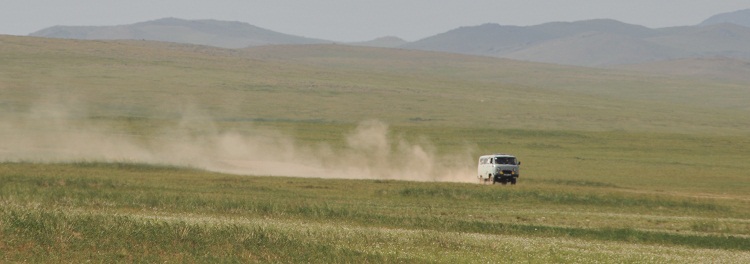
Our vehicle for the trip “The Pimp Wagon”, a Russian minivan with padded blue and white leather owned by the super-nice Toroo who was not only a great driver but also a brilliant mechanic. No Mongolian trip is complete without a least one breakdown and we had our fair share with a gas pump that needed to be replaced in the desert in 40+ degrees heat. Fortunately we had all sorts of spare parts packed because garages aren’t really easy to come by in the middle of nowhere. We also had to regularly drive against the wind to cool down the car or stop to pour cold water over the engine. This is when you realise how unforgiving rural Mongolia can be and you are grateful that you’re not doing this by yourself.
We really came to love the pimp wagon as we spent a lot of time driving to get from one major point of interest to the next. The impressive landscape made the long drives worthwhile and we really feel we’ve seen a great variety of what Mongolia has to offer in a relatively short period of time. The main highlights in the Gobi were definitely the “Flaming Cliffs” at Bayanzag where in the 1920s dinosaur bones and eggs were found, Yolyn Am, a valley in the middle of the roasting Gobi with a beautiful canyon which still had a tiny bit of ice left from the winter and the famous Khongor sand dunes which are up to 300m high and are well worth climbing. All these different types of landscapes in one area! We also saw ancient rock art (petroglyphs) in the South but don’t ask us how to pronounce the sites let alone find them again. They are estimated to be stone-age or even older.
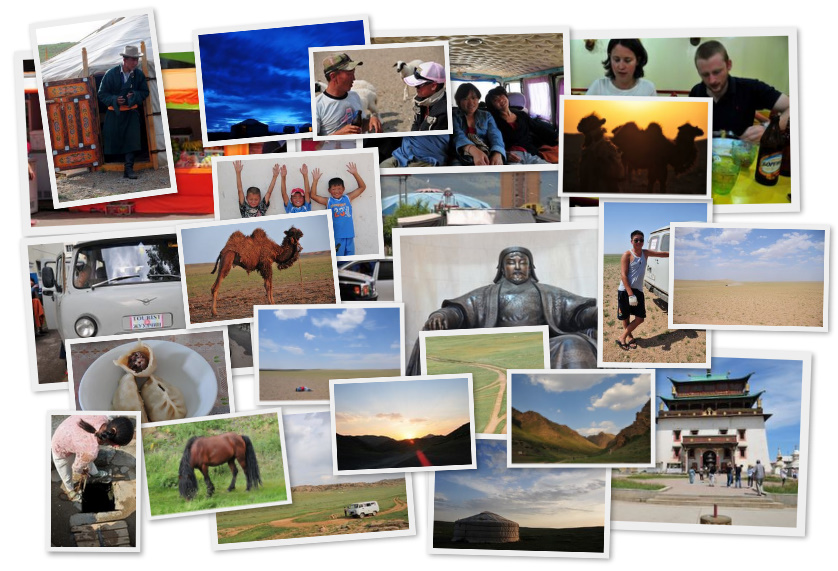
At Khongor we explored the dunes on camels that belonged to the ger we were staying at. Horses, camels, goats and sheep are the livelihood of rural Mongolian families and they are treated well which was very nice to see. We wouldn’t have wanted to do a camel trek if this hadn’t been the case. The trek turned out to be a lot of fun despite me managing to fall of a camel and banging my head. We were told that camels can get scared very easily so there is evidence that that’s true. In fact our local guide also fell off when she tried to get on her camel or maybe she just did that in solidarity with me. Or maybe camels are simply cleverer than they look and they decided to teach us a lesson of respect 🙂
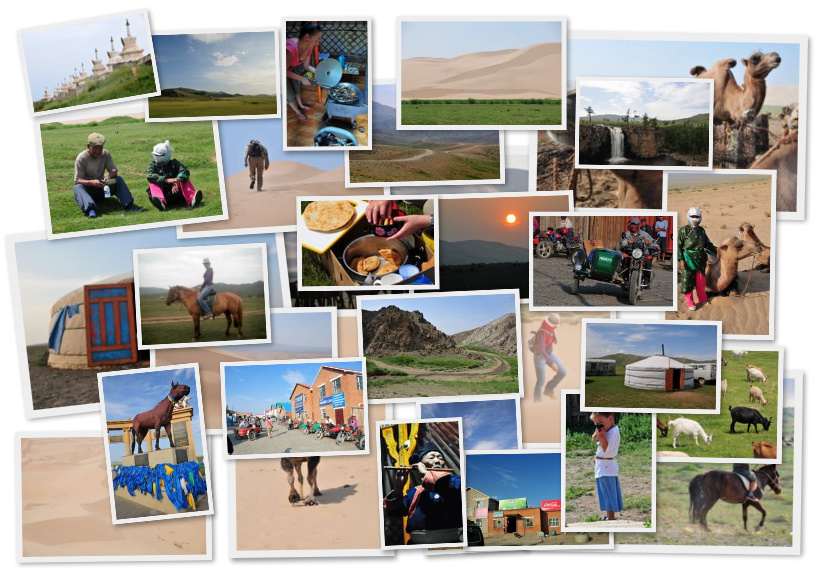
Camels are great but we still prefer horse treks. Horses are still one of the main means of transport in Mongolia and there is nothing better than exploring the countryside on the back of horse.We got the chance a little later on our trip at Orkhon waterfall which was brilliant but also tougher than we thought. Although Mongolian horses are small and look cute they’re generally pretty wild. At the beginning they definitely took us for a ride but after a while we managed to get better at it. James was a total natural and would have loved to continue for days. I was a bit hesitant after my camel experience but in the end I got a bit more confident and was pretty sad we had to get back in The Pimp Wagon.
Before we headed back to UB we stopped at Kharkhorin, Mongolia’s ancient capital during the Mongolian empire, to visit Erdene Zuu Khid, the first Buddhist monastry of the country. Kharkhorin itself is like most Mongolian towns full of half demolished Soviet-style buildings. It appears to be easier and cheaper to simply abandon buildings once they start falling apart and build a new building next to them rather than restore or tear them down. Unfortunately Erdene Zuu Khid is also only a shadow of what it must have been in the 16th century when it was constructed. Buddishm was nearly destroyed during in the 1930s when the communist government decided to plunder all monasteries and up to 30,000 monks were killed or sent of to Siberian labour camps. Since the fall of the iron curtain and the installment of a democratic government monks are allowed to practice Buddhism again and monasteries are open to visitors. Nowadays Erdene Zuu Khid is an important site for Mongolians and it’s worth seeing since there are hardly any monasteries left.
The drive from Kharkhorin to UB was a pleasant surprise because most of the 300 km stretch is an actual paved road. We had gotten used to dirt roads that lead through the middle of nowhere or simply no roads only grass. It was also weird to see people and cars passing by after days in the big nothingness of maybe one car per day. So getting back to UB was a treat, especially since we couldn’t wait to have a proper shower. Basic local gers generally have no showers and so whenever we came across a stream or a well we would stock up on water for cooking and washing ourselves. However our hopes were dashes when we arrived at UB there hadn’t been any hot water for days in the entire district. The water is literally ice cold so your hands get blue after 30 seconds under the water. But that’s all part of the Mongolia experience and we wouldn’t want to trade hot showers with having to work. Or maybe we would……… nah not really. Time to toughen up and appreciate the luxuries we usually have even more…
Hey Guys,
Awesome read and awesome photos! I didn’t realise there wasn’t any trees anywhere – it’s strange seeing such expanses of grass. No wonder they haven’t bothered with roads – no trees to run into.
Keep on having fun – very jealous back in cold Sydney.
Matt
hey guys, nice to see the photos and read about our trip. after just a few weeks those memories were fading due to the great trip i had up north on my horse trek. im back in ulaanbataar resting for a few days before heading back.
Hey Jason, good to hear you had an great time on your horse trek. We were thinking about you whenever it got really cold or it started raining. Can’t wait to hear more about your adventure. Facebook doesn’t work in China but as soon as we can access it again we’ll get in touch.